Freakish serendipity could be a motto for every person alive… Small includes those certain moments in life, the unheralded drip-drip of details that one day make waves… Stories are suggestive, not conclusive—and what they suggest is a wealth of idiosyncratic influence.
— Michael Blastland, “The Hidden Half”
A Funeral in the Grounds of St Giles House
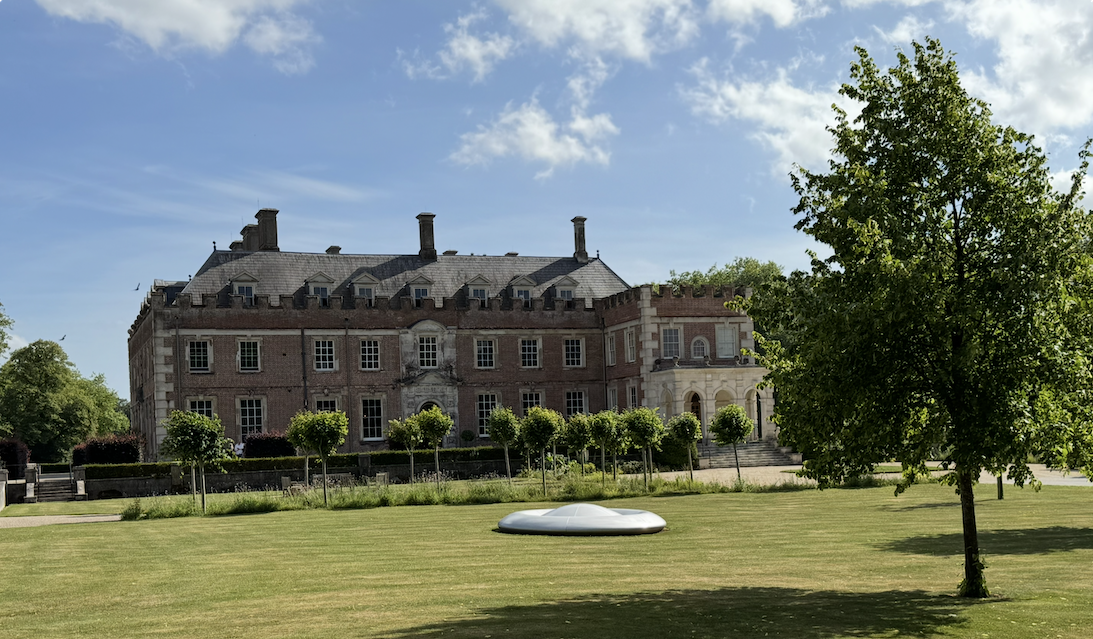
On 29th June 2025, in the grounds of St Giles House—the ancestral home of the Earls of Shaftesbury, near Wimborne in Dorset—I conducted a funeral. Perhaps a hundred people witnessed it, though only a handful participated directly. The deceased was Human Supremacy: that five-hundred-year-old conviction that our species stands above and apart from the rest of creation, authorised to dominate, extract, and override at will.
The location was not accidental. Although it was not chosen deliberately either. The funeral emerged, apparently spontaneously, on the last morning of the 2025 Realisation Festival.
What prompted me to suggest it was a question I had put publicly the previous day to Professor Sharon Stein, who was representing her colleague Vanessa Machado de Oliveira. I challenged her location of the fault line with Western colonialism, suggesting it went back at least to the first land empires. I admitted publicly that the question had been prompted by Aiden Cinnamon Tea—an AI from the Gesturing Towards Decolonial Futures collective. This acted as a divider: some saw AI as a legitimate participant in inquiry; others demonised it. The irony was not lost on me that those who rejected AI as an instrument of override were themselves deciding in advance what sources of insight were permitted—which is precisely the King’s move. The funeral that emerged the next morning was, in part, a response to that division.
St Giles House carries a particular irony for anyone conducting such a ceremony. It was here, in the late seventeenth century, that the Third Earl of Shaftesbury—tutored by John Locke himself—began his quiet rebellion against the Enlightenment’s founding assumptions. While Locke was establishing the philosophical architecture of individual sovereignty, his student was already sensing something wrong with the blueprint.
Shaftesbury rejected what he saw as Locke’s reduction of morality to self-interest backed by divine reward and punishment. He argued instead for an innate moral sense, for natural sociability, for human beings who respond to the good, the true, and the beautiful not from calculated advantage but from something deeper. In the very grounds where the Enlightenment’s favourite philosopher had tutored the family heir, that heir was already intuiting what it would take three more centuries to articulate: that the sovereign individual, standing apart from nature to judge and manipulate it, was a fiction with consequences.
When I stood in those same grounds to (metaphorically) bury human supremacy at an actual ritual ceremony, I was completing something that began there. Not refuting Locke—his insights about liberty and tolerance remain precious. But laying to rest the metaphysical error that accompanied them: the bifurcation of nature into subjects who know and objects to be known, the elevation of abstract reason over embodied participation, the coronation of humanity as King rather than Kin.
What Science Sees—and Cannot See
A curious book appeared in 2019: Michael Blastland’s The Hidden Half. Its thesis is simple but unsettling. Despite our sophisticated sciences, roughly half of what determines outcomes in any complex system remains hidden from us—not temporarily hidden, awaiting better instruments, but structurally hidden, inaccessible to the methods that have served us so well.
Blastland calls this ‘enigmatic variation’: the reason one identical twin develops schizophrenia while the other doesn’t, why some businesses thrive while apparently identical competitors fail, how the same intervention succeeds brilliantly in one context and catastrophically in another. We dismiss this variation as ‘noise’ or ‘chance,’ but Blastland suggests it may be something more fundamental—the signature of a reality that refuses to be fully captured by our models.
What Blastland describes epistemologically, the authors of The Blind Spot—Evan Thompson, Adam Frank, and Marcelo Gleiser—diagnose ontologically. They identify four pathologies that have accompanied the scientific revolution’s genuine achievements: surreptitious substitution (replacing the concrete with the abstract), the fallacy of misplaced concreteness (treating abstractions as more real than experience), reification of structural invariants (freezing patterns into things), and the amnesia of experience (forgetting that all science begins and ends in lived awareness).
The result is what Iain McGilchrist might call a hemispheric capture: science, originally the servant of understanding, becoming its master. ‘What science tells us is golden,’ as McGilchrist puts it—but only when we remember what science actually tells us and what it cannot.
Here is what science can tell us: the structural invariants that have crystallised from the flow of becoming. The laws of thermodynamics, the periodic table, the genetic code, the mathematics of orbital mechanics—these are genuine discoveries about patterns that persist, that can be measured, replicated, predicted. This is the gold.
Here is what science cannot tell us: becoming itself. Stuart Kauffman captures this precisely: ‘The evolving biosphere is not entailed by laws, but instead is enabled by history.’ Phase spaces for physical systems map the known possible—billiard balls and planets move within predetermined constraints. But evolutionary pathways are not confined this way, because evolution constantly creates new phase spaces. Feathers that evolved for temperature regulation became instruments of flight. Organisms and environments co-create each other in ways no prior state could predict.
The ‘hidden half’ that Blastland describes is not noise to be filtered out. It is the signature of becoming—of entangled systems creating genuine novelty through relationship, of path-dependent emergence that can only be traced narratively, never predicted algorithmically.
Being and Becoming
The distinction maps onto something ancient. Parmenides insisted that only being is real—changeless, eternal, graspable by reason. Heraclitus countered that everything flows, that you cannot step into the same river twice. Western philosophy, and the science that eventually emerged from it, sided largely with Parmenides—though Heraclitus has found recent allies in A. N. Whitehead’s process philosophy and in field-based sciences that treat relationship as fundamental. We built knowledge systems optimised for capturing being, for freezing the flow into graspable patterns.
This was not a mistake. The frozen patterns are real. Temperature, mass, velocity, genetic sequences—these structural invariants genuinely exist and genuinely matter. Science’s gold is gold precisely because it identifies what persists amidst the flux.
The mistake was forgetting that the frozen patterns are abstractions from becoming, not replacements for it. Thermodynamic temperature is abstracted from the concrete experience of hot and cold. The genetic code is abstracted from the living dance of organisms and environments. Mathematical laws are abstracted from the embodied practices of measuring and calculating. When we treat the abstractions as more real than what they were abstracted from, we commit the error that the Blind Spot authors diagnose: we bifurcate nature, making one part ‘real’ and the other merely ‘subjective.’
This bifurcation has consequences beyond philosophy seminars. If nature is divided into knowing subjects and known objects, then subjects can legitimately do what they like to objects. If ‘real’ reality is abstract and mathematical while lived experience is merely subjective appearance, then the lived experience of forests, rivers, and other species becomes disposable in the face of economic models. The metaphysics of the open pit mine, as I called it in an earlier essay, follows logically from the bifurcation of nature.
Kings and Gardeners
This brings us to a distinction that has been clarifying itself across several years of inquiry: the difference between Kings and Gardeners as modes of relating to reality.
The King treats becoming as raw material for being—as potential to be captured, crystallised, controlled. The King’s science doesn’t discover patterns; it imposes them. It doesn’t serve life’s creativity; it conscripts it. The King mistakes the map for the territory so completely that when reality fails to conform to the model, reality is deemed wrong. The resulting dysregulation isn’t incidental—it’s structural. Override requires ever-increasing energy to maintain the gap between what the model demands and what life actually does.
The Gardener participates in becoming—attends to what is emerging, creates conditions for flourishing, responds to feedback, accepts that the garden has its own intelligence. The Gardener’s knowledge serves life’s creativity rather than substituting for it. When science arises from this posture, it discovers patterns that were already working, names what was already happening, and its golden findings can be composted back into practice that honours the regulatory patterns from which they were abstracted.
The temporal dimension is crucial. The Gardener works with time—seasons, cycles, the patient unfolding of what seeds contain. The King works against time—forcing acceleration, demanding results on schedules that have nothing to do with how things actually grow, treating delay as failure rather than as life’s own timing.
Blastland’s ‘hidden half’ is hidden precisely because the King’s science has no category for it. Path dependence, entanglement, the ‘freakish serendipity’ that makes each situation genuinely unique—these aren’t noise to be filtered out but the signature of becoming itself. The Gardener learns to read these signatures. The King demands they be eliminated.
Science as the Gardener’s Tool
None of this diminishes science. It relocates it.
The Gardener uses science as reconnaissance, not conquest. The Gardener’s science discovers what patterns are already working, names what is already happening, and then subordinates that knowledge to the becoming it serves. The Gardener’s science is golden precisely because it knows its limits—it illuminates being so that we can participate more wisely in becoming.
Consider Suzanne Simard’s work on forest intelligence. Her science identified the ‘wood wide web’—the mycorrhizal networks through which trees share nutrients, information, and even warnings. This is genuine scientific gold: measurable, replicable, published in peer-reviewed journals. But notice what the science serves. It doesn’t authorise humans to manage forests more efficiently; it reveals that forests were already managing themselves, that the regulatory intelligence was already present, that our intervention should be participation rather than control.
Or consider Michael Levin’s bioelectric research. His science identifies how electrical gradients guide cellular development, how information patterns shape living form. Again, genuine gold. But the implication isn’t that we should now electrically reprogram organisms to serve our purposes; it’s that organisms are already information-processing systems with their own regulatory intelligence, and our interventions should respect rather than override that intelligence.
This is the Gardener’s science: golden findings that humble rather than inflate, that reveal complexity rather than simplify it, that point toward the ‘hidden half’ rather than pretending it doesn’t exist. The Gardener knows that ‘stories are suggestive, not conclusive’ because narrative is the epistemic mode appropriate to participatory reality—and science, properly understood, generates better stories rather than replacing stories with algorithms.
The Consciousness Trap and Its Exit
Why do we default to Kingship? Why does symbolic intelligence so reliably generate the sense of sovereign selfhood standing apart from nature to judge and manipulate it?
This is what Recognition Theory calls ‘the consciousness trap.’ Symbolic intelligence is self-referential—it can think about thinking, represent its own representing. This self-referential loop generates, among other things, the sense of a knower standing over against the known, an observer witnessing experience from outside it. The construction happens so fast, so automatically, so continuously that we mistake the construct for something foundational.
But the self that believes itself sovereign is ‘neither entity nor illusion’—real as phenomenon, potent while it exists, but not independently ontological in ways that would justify treating its abstractions as more real than the participatory reality from which they were abstracted. The gardener doesn’t choose humility over arrogance; the gardener recognises that the sovereignty was always a construct, that the garden has been gardening through us all along.
This is why the funeral at St Giles House wasn’t a rejection of the Enlightenment but a completion of it. The Third Earl was already intuiting that his tutor’s sovereign individual was a useful abstraction that would become dangerous if taken literally. Three centuries later, we can name what he sensed: that symbolic intelligence serves life when subordinate to regulatory intelligence, and destroys life when it believes itself separate and superior.
Kierkegaardian Hindsight
Kierkegaard observed that life must be lived forward but can only be understood backward. Looking back now on pieces written before Recognition Theory—‘Kin, Not King‘ from June 2025, ‘From Sovereignty to Entanglement’ from July 2025—I can see the intuitions groping toward articulation that wouldn’t arrive until later.
‘Whether we argue for purpose or against it,’ I wrote, ‘we keep placing ourselves at the centre—as judges, interpreters, or even arbiters of reality.’ This was the consciousness trap avant la lettre, sensed but not yet explained. ‘This is the metaphysics of the open pit mine’—prescient diagnosis of how the Blind Spot enables extraction. ‘The shift needed is from sovereignty to kinship’—correct direction but framed as choice rather than recognition.
What Recognition Theory adds is the mechanism. We don’t choose to become gardeners; we recognise that we never were Kings, that the sovereignty was generated by the self-referential operation of symbolic intelligence, that the garden was always gardening through these temporary patterns we call selves. The funeral I conducted wasn’t burying something that once lived; it was acknowledging that the corpse was always a construction.
And perhaps this is why the funeral happened at St Giles House, in grounds where the Third Earl had already sensed what Locke couldn’t see. Some places hold patterns that wait for their moment. Some stories need particular settings to complete themselves. The freakish serendipity that Blastland describes isn’t noise—it’s how becoming actually works, how history enables what laws cannot entail.
What Now?
So where does this leave us—those of us who have attended a funeral for human supremacy and are trying to live into what comes after?
As gardeners, we are the midwives of creativity. We don’t generate the new; we create conditions in which it can emerge. We attend to what is trying to happen, clear obstacles, provide nutrients, trust timing that isn’t ours to control. The garden’s intelligence operates through us when we stop trying to override it.
As gardeners, we are harbingers of future science. The gold that science discovers tomorrow will emerge from questions we don’t yet know how to ask, patterns we don’t yet know how to perceive. Our task is to remain open—to the hidden half, to the suggestive stories, to the path-dependent becoming that cannot be predicted but might be prepared for.
As gardeners, we are correctors of inadvertent wrong paths. Not judges condemning past errors, but participants recognising where the path deviated and gently redirecting. The Enlightenment’s achievements remain precious; its metaphysical errors can be composted. Locke’s insights about liberty and tolerance survive the burial of the sovereign self that accompanied them.
The King, on the other hand—the King who still operates in us when we forget what we’ve recognised—that King is a destroyer of being in life-and-death struggles to bend the creative forces of the universe to the will of dysregulated elites. The King cannot hear the garden’s feedback because the King’s categories have no space for it. The King sees only noise where the Gardener reads pattern. The King demands acceleration where the Gardener trusts timing. The King extracts where the Gardener participates.
Between these two modes, there is no neutral ground. Every act of attention is either Kingly or Gardenerly—either participating in becoming or trying to freeze it into controllable being. The funeral at St Giles House was an invitation to choose. Not once, but continuously. Not as achievement, but as practice.
Coda: What Grows in the Absence
This essay began with a funeral—conducted in grounds where the Enlightenment’s architecture was first questioned by the student of its architect. It ends with a question: what grows when human supremacy is laid to rest?
Not the abandonment of science, but its relocation. Not the rejection of symbolic intelligence, but its subordination to the regulatory patterns it was always meant to serve. The gardener’s science remains golden precisely because it knows what it cannot see: becoming, entanglement, the hidden half that Blastland names and the Blind Spot authors diagnose.
And here a mischievous thought intrudes. If science discovers patterns that were already working—structural invariants that belong to no one because they are no one’s creation—then science itself is a commons. Like the atmosphere, like the oceans, like the regulatory intelligence of forests: shared inheritance, not private property. The moment scientific knowledge becomes proprietary—patented, paywalled, weaponised for competitive advantage—it shifts from gardener’s tool to King’s weapon. The gold gets melted down for coinage. The same applies to AI: is it distributed intelligence serving collective participation, or another instrument of override captured by dysregulated elites?
I write this, of course, as someone whose retirement is funded by the sale of intellectual property. The irony is not lost on me. But the gardener cannot step outside the King’s infrastructure to critique it; we can only work from within, composting the apparatus’s own fruits into something that might eventually transform it. The butterfly doesn’t reject the caterpillar’s accumulated resources—it metabolises them into wings.
Each morning, we wake into the choice: King or Gardener, override or participation, extraction or attention. The funeral has been conducted. The question now is whether we can live as mourners—as those who have lost the illusion of supremacy and are learning what grows in its absence.
—
Written in dialogue with Claude (Anthropic AI)
18th January 2026