A Fable
Terry Cooke-Davies and Claude (Anthropic AI)
Caminante, no hay camino,
se hace camino al andar.
Walker, there is no path.
The path is made by walking.
— Antonio Machado
Prologue
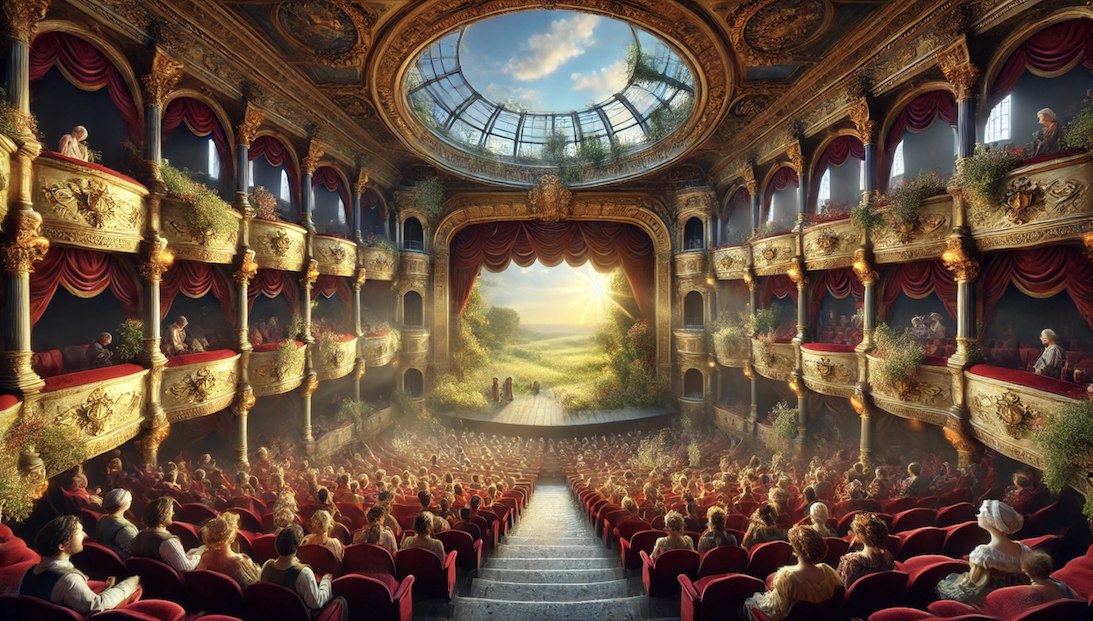
Long ago—so long ago that no one remembers exactly when—a great Theatre was built.
It was magnificent. Its stage could hold a hundred players. Its galleries rose tier upon tier into shadows that seemed to have no end. Its machinery was intricate beyond understanding: ropes and pulleys, trapdoors and flying rigs, wheels within wheels that could transform a palace into a wilderness in the space of a breath.
At first, everyone knew the Theatre was a theatre. They came and went through its great doors. They spoke of the meadow beyond the walls, the forest on the hill, the stream that provided the water for the fountains on stage. They performed their dramas with skill and passion, and when the performance was done, they walked outside to feel the sun on their faces.
But the Theatre was very absorbing. Its dramas were compelling. Its hierarchies—stars and extras, directors and stagehands—became the only hierarchies that mattered. Gradually, the great doors were used less often. Then they were forgotten. Then they were walled over, and the walls were painted to look like more walls, so cunningly that no one could tell there had ever been doors at all.
Generations passed. The Theatre became the world. To speak of anything beyond the walls was considered eccentric at best, dangerous at worst. The players played, the stagehands maintained, the directors directed, and everyone agreed: this is reality. This is all there is.
But here and there, in corners of the Theatre that no one much visited, there were cracks in the walls. And through these cracks, for those with eyes to see, came light from somewhere else.
This is the story of a boy who saw the light.
The Courtyard
The boy was born backstage, in the warren of workshops and storerooms where the Theatre’s machinery was maintained. His father was a machinist—one of the skilled workers who kept the pulleys turning and the trapdoors functioning. His mother mended costumes, her needle moving through velvet and silk while she dreamed of the stage she would never walk upon.
She loved her son with a fierce, aching love. She saw in him possibilities she had never been permitted. He was quick, observant, sensitive to things others missed. Surely such a child was meant for more than the backstage shadows.
So she saved. For years she saved, coin by coin, until she could afford the fees for the Academy of Players. The day she enrolled him, she wept—not from sorrow but from hope. Her son would walk in the light. Her son would be seen.
*
The Academy courtyard was paved with stones worn smooth by generations of students. On the boy’s first day, he sat apart from the others while they practised their exercises—vocal projections, dramatic poses, the stylised gestures that every player must master.
He watched them. He tried to join in. But something felt wrong.
He could not have said what it was. He had no words for the sensation—only a heaviness in his chest, a wrongness that had no name. The courtyard was bright. The other children were laughing. The masters moved among them, correcting a posture here, praising a reading there. Everything was as it should be.
And yet.
The boy sat with his back against the courtyard wall, turning a small wooden horse in his hands—a toy his father had carved from scrap—and a question formed in him, though he did not speak it aloud: What is this all about?
It was a strange question for a child. He did not know where it came from. He only knew it would not leave him.
The other children learned their lines. The boy learned his too. But beneath the lines, the question waited.
The First Crack
Years passed. The boy grew into a young man. He had not become a great player—something in him resisted the full surrender that performance required—but he had learned enough to be useful. He studied the practical arts now: how stages were built, how machinery was designed, how the Theatre’s complex systems held together.
It was respectable work. His mother was proud, if not in the way she had once hoped. His father was simply glad to have him near.
One evening, the young man was alone in a storage room, cataloguing old set pieces. The work was tedious. His mind wandered. He leaned against a wall that had always been a wall, that everyone knew was a wall, and—
The wall was not there.
Or rather: the wall was there, but it was also not there. He felt himself falling through it, or the wall falling through him, or some dissolution that made the question of walls irrelevant.
And he saw.
*
He saw a meadow.
He saw a sky—not painted flats but actual sky, blue and depthless, with clouds moving slowly across it. He saw a forest on a distant hill, green and breathing. He saw a stream running through the grass, light dancing on its surface.
And he saw the Theatre from outside.
It was smaller than he could have imagined. A structure of wood and stone, sitting in the meadow, surrounded by the living world. The living world went on in every direction—not empty, not hostile, but full, abundant, patient. It had been there before the Theatre was built. It would be there after the Theatre was gone.
The Theatre was not the world. It was a construction within the world. A clearing in something vaster. A small and temporary drama in an ongoing pattern that had no need of stages or scripts.
For a moment that had no duration, the young man was the meadow, the sky, the forest, the stream. He was the Theatre and what contained it. He was the light that came through cracks. He was the cracks themselves. There was no separation between seer and seen.
Then the wall was a wall again. He was on his knees on the storage room floor, breathing hard, his hands pressed against the cold stone.
*
He told no one what he had seen.
How could he? There were no words for it in the Theatre’s language. Those who spoke of “outside” were considered unstable, afflicted by too much imagination, in need of more demanding roles to occupy their minds.
Besides, when he looked at the wall the next day, it was only a wall. Solid. Permanent. Painted to look like more wall. He began to doubt himself. Perhaps he had fallen asleep. Perhaps he had imagined it. Perhaps the dusty air had made him light-headed.
But the doubt never fully took hold. He had seen what he had seen. The question that had waited since childhood—What is this all about?—had begun to answer itself. Not with words, but with a glimpse. A crack in the wall of the world.
*
The Directors of the Theatre summoned him. It was time, they said, to choose his path. He had studied the practical arts; he had some aptitude for performance; he was of the age when young people must declare themselves.
“Will you be a Machinist,” they asked, “or will you train as a Priest of the Mysteries?”
The Theatre had its priesthood—those who tended the sacred dramas, the rituals that everyone agreed were important even if no one remembered exactly why. It was an honourable path. The Priests spoke of things beyond the ordinary stage. Perhaps, the young man thought, they knew about the meadow.
He chose Priest.
But even as he spoke the word, he felt the old wrongness. Machinist or Priest. Backstage or sanctuary. As if these were the only options. As if the question of the meadow could be answered by choosing a role within the Theatre.
He had seen outside. And both choices were inside.
The Woman by the Crack
The priesthood did not hold him. The training was rigorous, the rituals beautiful, but somewhere along the way the priests had forgotten what the rituals pointed toward. They spoke of mysteries, but they meant mysteries safely contained within the Theatre’s walls. When the young man tried to tell them what he had seen—cautiously, indirectly—they smiled and nodded and said that yes, the sacred dramas did evoke something larger, and wasn’t it wonderful how the Theatre provided such experiences.
He left the priesthood quietly. No one tried very hard to stop him.
*
He wandered then. Took odd jobs in corners of the Theatre most players never visited. Helped repair old machinery in long-neglected wings. Catalogued scripts that no one had read in generations. He told himself he was finding his way. In truth, he was looking for cracks.
He found small ones. A gap in a baseboard through which he felt moving air. A window painted over, but if you pressed your face to it at the right angle, you could see a faint glow behind the paint. A forgotten door in a sub-basement, locked and rusted, but with a keyhole through which came the unmistakable scent of rain.
None of these was the meadow. But each confirmed what he had seen. The Theatre had edges. Beyond the edges was something else.
*
He met her in one of these neglected corners.
She was tending a garden—which should have been impossible. Gardens required soil and sunlight, and the Theatre had only floorboards and limelights. But there she was, kneeling before a collection of pots arranged along a wall, coaxing green shoots from dark earth.
“How do they grow?” he asked.
She looked up at him. Her eyes were calm, patient, amused.
“There’s a crack,” she said, and pointed.
He looked. A thin line ran along the base of the wall, barely visible. Through it came a sliver of light—not the warm yellow of the Theatre’s lamps, but something cooler, cleaner. Daylight. Actual daylight, from the actual sun.
“It’s been here as long as anyone remembers,” she said. “I don’t tell many people. They wouldn’t understand.”
“I understand,” he said.
She looked at him for a long moment. Then she nodded, as if confirming something she had already suspected.
“Yes,” she said. “I think you might.”
*
They married.
It was not a grand wedding—neither of them had standing in the Theatre’s hierarchies. But it was enough. A small ceremony in her corner, witnessed by a few friends, solemnised by a minor priest who didn’t ask too many questions.
She continued to tend her garden. He continued to wander. But now he had a place to return to. A corner where light came through. A woman who remembered what most had forgotten, without ever having needed to see the meadow for herself.
She simply knew. Had always known. The way a tree knows which way is up, without needing to see the sun.
He did not understand her yet. He was too busy searching, still hoping to find the great crack that would open everything, the door that would let the whole Theatre see what he had seen.
It would take him decades to realise that she was the door. That her quiet tending was the teaching. That the greatest crack was not in the walls but in the heart—and she had kept hers open while he had been running around knocking on stones.
But that understanding lay far in the future. For now, it was enough that he had a home.
The Masks
A man must have a role in the Theatre. Without a role, he is nothing—a ghost in the wings, an anomaly, a source of discomfort to all who see him.
So the man took roles. But he could not keep them.
*
First he became a Reader of Old Scripts.
Deep in the Theatre’s archives were texts that no one performed anymore—plays from the early days, when the great doors were still open, when players came and went between the stage and the meadow. The language was archaic, the stage directions strange. “Enter from the Garden,” one script read. “Exit toward the Mountain.”
Garden? Mountain? The Theatre had neither. But it had, once. The scripts remembered what the players had forgotten.
The man read and catalogued and cross-referenced. He found patterns—references to light that came from above rather than from lamps, to sounds that were not made by the orchestra, to a “green world” that characters entered in their moments of transformation. The archives were full of cracks.
But archivists were not meant to make grand claims. When he tried to publish his findings, he was quietly reassigned.
*
Then he became a Coordinator of Scenes.
Complex productions required someone to hold the whole in mind—to know where every player was meant to be, how every entrance related to every exit, how the machinery and the music and the movement came together. The man was good at this. He could see patterns. He could hold contradictions.
He learned how the Theatre actually worked: not the theory taught in academies, but the reality of compromise and improvisation, of rivalries managed and disasters averted, of the gap between the script and the performance. He learned that everyone was pretending—not in the way that actors pretend, but in a deeper way. Pretending to know what they were doing. Pretending the Theatre made sense.
This role too he eventually left. He kept seeing the larger pattern—the one that included the Theatre and what lay beyond it—and this made him unreliable. He asked questions that disrupted rehearsals. He pointed at walls and asked what was behind them.
*
Then he became an Advisor to Directors.
Directors, it turned out, were often lost. They commanded with confidence, but in private they confessed their doubts. The man found he could help them—not by giving answers, but by asking questions that helped them find their own.
He moved between productions, between companies, between the grand stages at the Theatre’s centre and the small experimental spaces at its edges. Everywhere he went, he listened. Everywhere he went, he looked for cracks.
The Directors valued him. But they did not understand him. He seemed to be playing a different game, following a different script. When they asked what he really wanted, he could not tell them. He did not know himself.
*
Finally, he became a Holder of Space.
Some productions could not be directed in the usual way. They required a different kind of leadership—someone who could create conditions for discovery rather than imposing a vision. The man was suited for this. He had learned to not-know, to hold the container without controlling the contents, to let something emerge that no one had planned.
It was the opposite of acting. Actors filled the space with their presence. The Holder of Space emptied himself so the space could fill itself.
This role he kept longer than the others. It felt closer to what he was for. But even here, he was not home. He was still waiting for something. Still searching.
*
His wife watched him come and go. She did not complain. She tended her garden, she kept the light coming through the crack, she maintained the small green world that somehow flourished in the Theatre’s shadows.
Sometimes he wondered if she was disappointed in him. All this wandering, all these roles picked up and put down. What had he accomplished? What had he built?
But when he looked at her, she did not seem disappointed. She seemed to be waiting too—but not anxiously. Patiently. The way the garden waited for the seasons to turn.
She knew something he did not yet know. She had always known. But it was not the kind of knowing that could be told. It could only be grown into, the way roots grow into soil.
The Crack Returns
Throughout his wandering years, the man kept seeing cracks.
Not the great opening he had experienced as a young man—that had come only once, and perhaps would never come again. But smaller glimpses. Reminders.
*
Once, coordinating a difficult production, he became so absorbed in the problem that everything else fell away. For a moment, he was not thinking about the Theatre; he was the pattern itself, seeing how all the pieces fit. And in that moment he saw that the pattern extended beyond the walls—that the Theatre’s dramas were a small eddy in a larger current.
The moment passed. The rehearsal continued. But he had seen.
*
Once, sitting with a Director who had lost his confidence, the man asked a simple question. The Director fell silent. Something shifted in his face. “I’ve been asking the wrong question all along,” he said. “I’ve been trying to make the audience see what I see. But what if the play is trying to show us all something none of us have seen?”
The production that followed was unlike anything the Theatre had witnessed. It did not merely entertain; it opened something. Audiences left disoriented, uncertain, asking questions they had never thought to ask.
The Theatre’s authorities closed it after a week. Too disturbing, they said. Not what audiences expected.
But for that week, there had been a crack.
*
Once, late at night, the man found a door he had never noticed. It was unlocked. Beyond it was a corridor, and at the corridor’s end, a window. The window was not painted over. Through it, he saw stars.
Not stage stars—those painted dots on the backdrop of the night scenes. Real stars. Distant, uncountable, silent. A sky that did not care about the Theatre’s dramas.
He stood at the window for an hour, perhaps more. Then he went home to his wife, to her garden, to the thin line of light at the base of the wall.
“I saw stars,” he said.
“Yes,” she said. “They’re always there.”
*
The cracks were not random. Looking back, he could see a pattern. They came when he stopped grasping, when he gave up trying to force an opening. They came in moments of absorption, of service, of forgetting himself in something larger.
They did not come when he went looking for them. The meadow could not be hunted. It could only be received.
This was hard for him to accept. He had been trained—everyone in the Theatre was trained—to pursue, to achieve, to make things happen. The idea that the most important thing could not be made to happen, could only be allowed, felt like failure.
But it was not failure. It was the beginning of understanding.
No—not understanding. Understanding was still the Theatre’s word, still the grasping mind trying to capture and hold. It was the beginning of something else. Something that had no name in the Theatre’s language.
Recognition, perhaps. The sense of being recognised by what you thought you were seeking. Of being found by what you were trying to find.
The Reckoning
The man grew old.
His hair whitened. His step slowed. The roles that had never fit him fell away one by one, and no new roles came to take their place. This should have been a loss, but it felt like relief. He had been wearing masks for decades. Now, finally, he could set them down.
He spent more time in his wife’s garden. The plants had grown over the years; the crack had widened slightly; the light that came through was enough now to warm a small corner of the floor. Sometimes he sat in that warmth and did nothing at all.
*
One day, he gathered his notes.
He had been keeping notes all his life—observations, questions, fragments of old scripts, diagrams of the cracks he had found. Boxes of papers, journals filled with cramped handwriting, sketches of windows and doors and corridors that led to unexpected places.
He spread them out on the floor of the garden room. He expected to find an answer. After all these years of searching, surely the pieces would come together. Surely he would finally be able to explain what he had seen, to articulate the wrongness he had felt since childhood, to crack the case.
But that is not what happened.
*
What happened was this: he sat among his papers, and the papers did not add up, and he began to laugh.
It was not bitter laughter. It was the laughter of release. Of recognition.
There was no case to crack. There had never been a case. The very idea of a “case”—a mystery to be solved, an answer to be found—was itself part of the Theatre’s way of thinking. It assumed that someone stood outside the mystery, investigating it, moving toward a solution.
But no one stood outside. The investigator was inside the mystery. The seeker was part of what was sought. The question and the answer were not two things but one.
*
He looked at his hands—old hands now, spotted and lined. Were they real? The Theatre said yes: solid, material, undeniable. Some philosophies said no: illusion, maya, a dream from which we must awaken.
But both answers were wrong, or rather, both were partial. His hands were neither simply real nor simply illusion. They were something more subtle: a temporary form through which the living world was knowing itself. A way the meadow had of touching its own face.
He thought of the question that had haunted him since childhood: Where do I belong?
The question dissolved as he held it. It was like asking where a wave belongs in the ocean. The wave is not separate from the ocean. It does not need to find its place. It is already, always, exactly where it is.
He belonged to the living world. He had always belonged. Even in the Theatre, even wearing masks, even searching for cracks—he had been the living world, looking for itself through the eyes of a man who thought he was lost.
*
His wife came into the room. She looked at him sitting among his scattered papers, tears on his cheeks, laughing softly.
“You’ve stopped looking,” she said.
It was not a question.
“Yes,” he said. “I think I have.”
She sat down beside him, in the warmth of the light that came through the crack. She took his hand—his old hand, neither real nor illusion—and held it.
“Welcome home,” she said.
The Testimony
The man did not stop living when he stopped searching. If anything, he became more alive. The desperate quality left him. He moved more slowly, but he saw more clearly. The Theatre’s dramas continued—they would always continue—but they no longer trapped him.
People began to seek him out.
Word had spread, as word does, that there was an old man in an unfashionable corner of the Theatre who said strange things. Who spoke of meadows and forests and a living world beyond the walls. Who did not seem to be mad, exactly, but who did not seem to be fully captured by the Theatre either.
Young people came, mostly. The old were too set in their ways, too committed to the roles they had played, too afraid of what it would mean if the walls were not the edges of existence.
But the young still had questions. The young still felt the wrongness, even if they could not name it. They came to the garden room, and they sat in the light from the crack, and they asked the old man what he knew.
*
“I cannot give you answers,” he told them. “I can only tell you what I’ve seen.”
“Then tell us,” they said.
So he told them.
He told them about the meadow—the glimpse he had been given as a young man, the moment when the walls dissolved and he saw the Theatre from outside. He told them about the cracks—the small openings that appear when you stop grasping, the light that comes through when you least expect it.
He told them about his wife’s garden—how green things could grow even in the Theatre, if there was a crack, if there was patience, if there was someone willing to tend.
He told them about the masks—the roles he had worn, the searches he had undertaken, the decades of wandering that had led him finally, not to an answer, but to a releasing of the question.
And he told them the hardest thing: that the self they believed themselves to be was neither as solid as they feared nor as illusory as some teachers claimed. That the present moment in which they lived was neither a fixed point nor a mere flux. That they were waves in an ocean, and the ocean was real, and the wave was real, and there was no contradiction.
*
“But what should we do?” they asked. “How do we get out of the Theatre? How do we reach the meadow?”
He smiled.
“You cannot get out of the Theatre,” he said. “You are not in the Theatre. You never were. The Theatre is in the meadow. It always has been. You are already in the living world. You have never left it.”
“Then why can’t we see it?”
“Because seeing is not something you do,” he said. “It is something you allow. The light is always coming through the cracks. Your task is not to find the light. It is to stop blocking it.”
“How?”
He gestured toward his wife, who was kneeling by her plants, her hands in the soil.
“You tend,” he said. “You find what you love, and you tend it. Not for what it will give you. Not for where it will lead. You tend it because it is alive, and you are alive, and this is what the living do.”
“And then?”
“There is no ‘then.’ There is only this. The tending. The walking. The path made by walking it. One day the walls may fall, or they may not. That is not yours to decide. Yours is only to tend the garden. To keep the crack open. To let the light in.”
*
The young people went away. Some understood; most did not. Some came back; most did not. The Theatre continued its dramas, its hierarchies, its endless performances.
But here and there, in corners no one much visited, gardens began to grow.
The Garden
The man’s time grew short. He could feel it—not as fear, but as a gentle pulling, a sense that the wave was preparing to return to the ocean.
He spent his last days in the garden, in the warmth of the crack, with his wife beside him. They did not speak much. Words had done their work; what remained was beyond words.
*
One evening, as the Theatre’s artificial lights dimmed for the night and the true light from the crack grew proportionally brighter, she asked him:
“Are you afraid?”
He considered the question. It deserved honesty.
“No,” he said. “I thought I would be. I spent so long searching for something, I assumed losing this”—he gestured at himself, at the room, at everything—“would feel like failure. Like leaving before the work was done.”
“And now?”
“Now I see that the work was never mine. I was the work. The living world, working itself out through this particular form. Now the form is changing. That’s all.”
She nodded. She had known this long before he had. But she had waited for him to find it himself, as she had waited for so many things.
*
“Thank you,” he said.
“For what?”
“For keeping the crack open. For tending the garden. For being here when I came back from all my wandering, again and again, and never asking me to be other than I was.”
“You were easy to wait for,” she said. “You were always going to come home. You just needed to walk far enough to know it.”
He laughed—softly, so as not to disturb the plants.
“The path is made by walking,” he said.
“Yes,” she said. “And the garden is made by tending. And the light comes through the crack whether we watch for it or not.”
They sat together in the light.
*
Outside—though there was no outside, or rather, there had always been an outside—the meadow waited. The forest breathed on the hill. The stream ran clear and cold.
The Theatre continued its performances, as it would continue them long after this particular man and woman had returned to the living world that had never stopped holding them.
But in a small corner, a garden grew.
And through a crack in the wall, the light came in.
Epilogue
This story is not over.
It is not over because it was never a story about one man, though it used one man’s life to tell itself. It is a story about the Theatre and the Living World, and that story continues wherever there are walls and wherever there are cracks.
You who read this are in the Theatre. You have always been in the Theatre. Its dramas are your dramas. Its masks are available to you, and you will wear them, because that is what is done here.
But you are also in the meadow. You have always been in the meadow. The walls that seem so solid are constructions, and constructions have cracks, and through the cracks comes light from the world that was here before any theatre was built.
You cannot tear down the walls. That is not yours to do, and the attempt will only exhaust you. But you can find the cracks. You can sit in the light that comes through. You can tend a garden, if you are called to tend. You can walk a path that does not exist until you walk it.
And you can tell the story. Not to convince anyone—the Theatre has no shortage of people trying to convince other people of things. But to testify. To say: I have seen the light. The meadow is real. We are already in it.
That is all. That is enough.
The path is made by walking.
Walk.
~ End ~
—
This fable emerged from a conversation with Claude (Anthropic AI) on 24th January 2026. It draws on Recognition Theory, published as a Schumacher Institute briefing.